Learning how to find internal and external link opportunities through competitor analysis is one of the most efficient ways to accelerate your SEO strategy. Instead of guessing which sites might link to you or which internal pages deserve more connections, you can reverse-engineer what's already working for your rivals.
Competitor backlink profiles are essentially roadmaps; they reveal who's willing to link out, what content earns links, and where gaps exist in your own site architecture. This guide walks you through a practical, step-by-step process for building a comprehensive link strategy rooted in competitive intelligence.
Whether you're an SEO professional managing multiple clients or a content marketer trying to grow organic traffic, these techniques will sharpen your approach. For a broader overview of discovery methods, our guide on how to find internal and external link opportunities covers the foundational concepts. The stakes are real: sites with strong link profiles consistently outrank those without them, regardless of content quality.
Key Takeaways
- Competitor backlink analysis reveals proven link sources you can replicate for your own site.
- Internal link gaps often become visible when you compare your site structure against top-ranking competitors.
- Free and paid tools both work; the difference is speed and scale of analysis.
- Prioritize link prospects by domain authority, relevance, and likelihood of response.
- Regular competitor monitoring turns link building from a one-time project into an ongoing system.
Step 1: Identify Your True Link Competitors
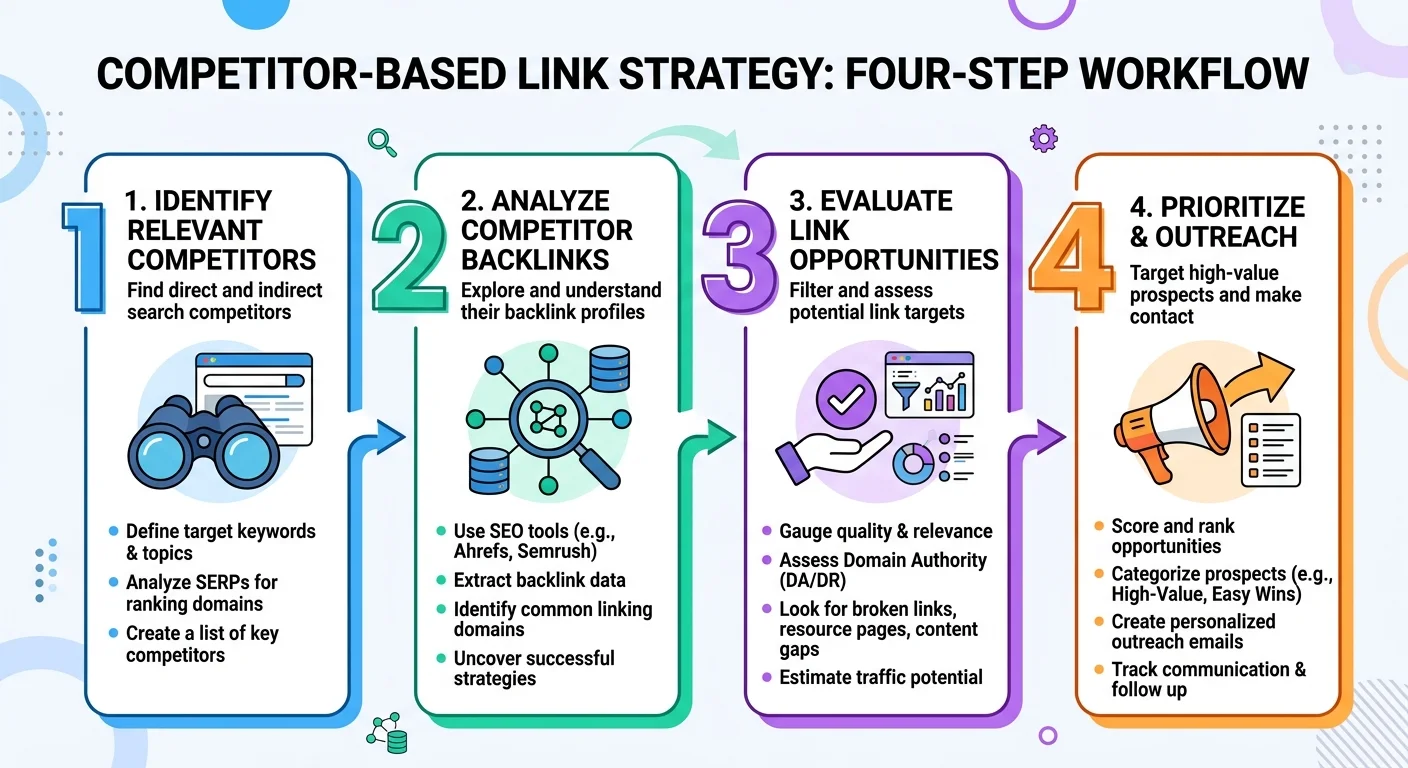
Your link competitors aren't always your business competitors. A SaaS company selling project management tools might compete for backlinks with productivity blogs, freelancer resource sites, and even academic institutions that rank for the same keywords. Start by listing the top 10-15 URLs that rank on page one for your five most valuable keywords. These are your SERP competitors, and their backlink profiles are the ones worth studying.
SERP-Based Identification
Run your target keywords through Google and document every domain that appears in the top ten results. Look for patterns: which domains show up repeatedly across multiple keyword sets? Those repeat offenders are your primary link competitors. A domain ranking for seven out of ten of your target terms has built a link profile specifically worth dissecting.
Create a spreadsheet with columns for competitor domain, number of overlapping keywords, estimated domain authority, and total referring domains to keep your analysis organized from the start.
Don't ignore domains that seem outside your niche. Sometimes a general-interest publication or a resource hub earns links from the same sources you're targeting. These "adjacent competitors" often reveal unexpected link opportunities, directories, resource pages, or editorial roundups that you'd never find through traditional prospecting alone. If you want a broader set of discovery methods, the 9 best ways to find internal and external link opportunities offer additional approaches beyond competitor analysis.
Separate your competitors into tiers: direct (same product or service category), indirect (overlapping content topics), and aspirational (dominant authority sites in your space). This tiering matters because you'll use different strategies for each. You can realistically replicate links from direct competitors, learn content strategies from indirect ones, and identify high-value targets from aspirational domains.
Step 2: Analyze Competitor Backlink Profiles
Once you've identified your competitors, pull their backlink data using tools like Ahrefs, Semrush, or Moz. Export the full list of referring domains for each competitor. You're looking for patterns, not individual links. Which types of sites link to them most frequently? Are they earning links from guest posts, resource mentions, data citations, or product reviews? The answers shape your entire outreach strategy.
Extracting Actionable Data
Filter backlinks by domain rating (DR 30+), dofollow status, and referring page traffic. A backlink from a DR 70 site with zero traffic to the linking page is less valuable than a DR 45 link on a page that gets 500 monthly visits. Context matters more than raw authority scores. Export these filtered lists and start categorizing link types: editorial mentions, guest contributions, resource page listings, broken links, and directory placements.
Look for "link intersections" domains that link to two or more of your competitors but not to you. These are your highest-probability targets because they've already demonstrated willingness to link within your topic area. Most backlink tools have an intersect feature that automates this comparison. Run it across your top five competitors, and you'll typically find 50-200 domains worth pursuing.
Pay attention to the content formats that earn the most links. If your competitors get heavy links to data-driven studies, infographics, or comprehensive guides, that tells you what type of content to create. You're not copying their content, you're understanding what the linking ecosystem rewards. Following website best practices for content structure and user experience also increases the likelihood that publishers will link to your pages over a competitor's.
Backlink data from any tool represents a sample, not the complete picture. Use at least two tools to cross-reference and get a more accurate view of competitor link profiles.
Step 3: How to Find Internal and External Link Opportunities From Gaps
Gap analysis is where competitor research transforms into an actionable strategy. Compare your own backlink profile against your competitors' profiles to identify domains that link to them but not to you. Simultaneously, examine how competitors structure their internal links, which pages they push authority toward, how deep their navigation goes, and where they cluster related content. Both external and internal gaps represent immediate opportunities.
Internal Structure Comparison
Crawl competitor sites using Screaming Frog or Sitebulb and map their internal linking architecture. Notice how many internal links point to their highest-ranking pages. Compare that to your own structure. If a competitor's top-performing article has 35 internal links pointing to it and your equivalent page has eight, that's a structural deficit you can fix today. For a deep dive into this process, our guide on how to find internal link opportunities on your site breaks down the technical steps.
| Metric | Competitor A | Competitor B | Your Site |
|---|---|---|---|
| Referring Domains | 1,240 | 890 | 310 |
| Internal Links to Top Page | 42 | 35 | 11 |
| Content Hub Pages | 6 | 4 | 2 |
| Resource Page Backlinks | 87 | 63 | 14 |
| Avg. DR of Linking Domains | 48 | 41 | 33 |
External gap analysis should produce a master prospect list. Cross-reference the domains linking to competitors against your own referring domains and remove any overlaps. The remaining domains are your targets. Categorize them by link type and note the specific page that links to your competitor — this context is essential for crafting relevant outreach emails that actually convert.
"The best link strategies aren't built from scratch — they're built on top of what competitors have already proven works."
Strengthening your internal linking strategies to boost SEO rankings is often the fastest win from competitor analysis. You can implement internal link improvements immediately without waiting for outreach responses. Add contextual links between related articles, build hub pages that competitors already have, and distribute authority more deliberately toward your money pages.
Run a "content gap" analysis alongside your link gap analysis. Pages your competitors rank for that you don't have yet represent both content and link acquisition opportunities.
Step 4: Build a Prioritized Outreach and Linking Plan
Raw prospect lists are useless without prioritization. Not every domain that links to a competitor is worth pursuing. You need a scoring system that accounts for domain authority, topical relevance, estimated traffic to the linking page, and the type of link (editorial vs. directory vs. forum). Assign weights to each factor based on your goals, then sort your prospect list by total score.
Scoring and Sequencing Prospects
A practical scoring model gives each factor a 1-5 rating. Domain authority above 50 gets a 5; below 20 gets a 1. High topical relevance scores 5; tangential relevance scores 2. Multiply relevance by 2 since it impacts ranking value disproportionately. A moderately authoritative but highly relevant site will typically move the needle more than a powerful site in an unrelated niche. Sort by weighted total and work from the top down.
Sequence your outreach in waves. Start with the easiest wins: broken links on competitor-linking pages where you have a direct replacement, resource pages that accept submissions, and sites where you have an existing relationship. Second wave targets are editorial sites that require a pitch — guest post opportunities, data citation requests, and expert roundup contributions. Reserve the hardest targets for wave three, when you have more published content and social proof.
Never send mass-templated outreach to your top-tier prospects. Personalized emails that reference specific content on the target site get 3-4x higher response rates than generic templates.
Track everything in a CRM or dedicated spreadsheet. Record the prospect URL, contact email, outreach date, follow-up dates, response status, and outcome. This data becomes invaluable over time; you'll spot patterns in what pitches work, which site categories respond best, and where to allocate future effort. Review your link strategy quarterly, re-run competitor analysis, and refresh your prospect list with new opportunities that emerge as competitors publish new content and earn fresh links.
Frequently Asked Questions
?How do I find SERP competitors for backlink analysis?
?Do free tools work as well as paid ones for competitor backlink analysis?
?How long does building a competitor-based link strategy actually take?
?Is it a mistake to only analyze direct business competitors for backlinks?
Final Thoughts
Building a link strategy with competitor analysis removes the guesswork that plagues most link-building campaigns. You're working with proven data instead of assumptions.
The process outlined here, identifying real competitors, extracting backlink patterns, mapping internal and external gaps, and building a scored outreach plan, creates a repeatable system you can run every quarter. Start with your top three competitors today, pull their backlink data, and you'll have a prioritized prospect list by the end of the week.
Disclaimer: Portions of this content may have been generated using AI tools to enhance clarity and brevity. While reviewed by a human, independent verification is encouraged.