Knowing how to find internal and external link opportunities is only half the battle. The real competitive advantage comes from executing a disciplined internal linking strategy that distributes authority across your pages, guides crawlers through your site architecture, and keeps visitors engaged longer.
Most websites leave enormous ranking potential on the table simply because they never build a systematic approach to connecting their own content. Internal links are one of the few ranking signals you control entirely, no outreach required, no waiting on third parties. This guide walks you through four concrete steps to build an internal linking framework that directly improves your search visibility.
Whether you manage a 50-page site or a 50,000-page content library, these strategies scale. For a broader look at both sides of the linking equation, our pillar guide on how to find internal and external link opportunities covers the complete picture.
Key Takeaways
- Audit your existing internal links before adding new ones to avoid redundancy and orphan pages.
- Use topic clusters to organise internal links around pillar pages for maximum topical authority.
- Prioritise linking from high-authority pages to underperforming content that needs a rankings boost.
- Anchor text should be descriptive and varied—never stuff exact-match keywords repeatedly.
- Schedule quarterly internal link audits to catch broken links and capitalise on new content.
Step 1: Audit Your Existing Internal Link Structure
Identify Orphan Pages
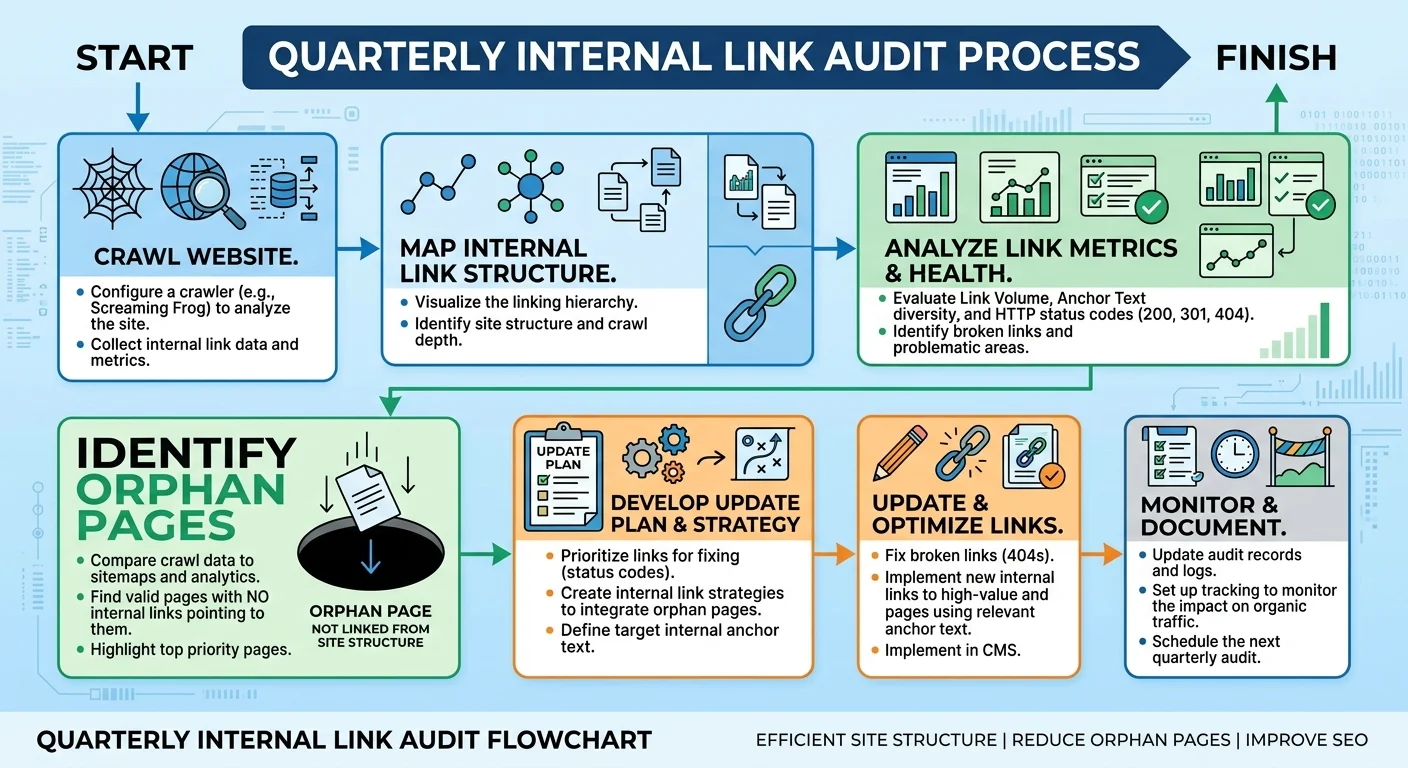
Before adding a single new link, you need a clear picture of what already exists. Run a full crawl of your site using Screaming Frog, Sitebulb, or Ahrefs' Site Audit tool. Export the results and sort pages by inlinks count—any page with zero or one internal link pointing to it is effectively an orphan. These pages struggle to get indexed, let alone rank, because search engines can barely find them.
Orphan pages are surprisingly common on sites that publish frequently without a structured linking workflow. A content team might produce three articles per week for a year and never link back to older pieces. The result is hundreds of pages floating in isolation. Fixing this alone can produce measurable ranking improvements within weeks, because you're redistributing existing authority to starved pages.
Map Link Distribution
Once orphan pages are flagged, examine how links are distributed across the rest of your site. Many websites overlink to their homepage and top-level category pages while neglecting deeper content. Create a simple spreadsheet mapping each URL to its inlink count, organic traffic, and target keyword. This reveals imbalances immediately; you'll spot high-potential pages that deserve more internal links and low-value pages hogging attention.
| Metric | What It Reveals | Tool to Use |
|---|---|---|
| Inlinks count | How many internal pages link to a URL | Screaming Frog |
| Crawl depth | How many clicks from the homepage | Sitebulb |
| Orphan page count | Pages with no internal links | Ahrefs Site Audit |
| Link equity flow | How authority is distributed across site | Moz Link Explorer |
| Broken internal links | Links pointing to 404 pages | Screaming Frog |
Export your crawl data into Google Sheets and use conditional formatting to highlight pages with fewer than three internal links—these are your immediate priorities.
Step 2: Build Topic Clusters With Strategic Internal Links
Choose Your Pillar Pages
Topic clusters remain the most effective way to organise internal links at scale. The concept is straightforward: one comprehensive pillar page targets a broad keyword, while multiple cluster articles target related long-tail variations. Every cluster article links back to the pillar, and the pillar links out to each cluster piece. This creates a tight web of topical relevance that search engines reward with higher rankings across the entire cluster.
Selecting pillar pages requires looking at your keyword research and identifying terms with high search volume and commercial intent. Your pillar should be the most authoritative, comprehensive page on that topic. For example, if you run an SEO tools blog, a pillar page might target "link building strategies" while cluster articles cover specific ways to find internal and external link opportunities, outreach templates, and anchor text optimisation. The pillar earns authority from every cluster page pointing to it.
"A well-structured topic cluster can increase organic traffic to the pillar page by 40-60% within three months of implementation."
Connect Cluster Content
Cluster articles shouldn't just link to the pillar—they should link to each other when the context is natural. If your cluster includes a post about finding internal link opportunities on your site and another about evaluating outreach targets, a mention of content quality in the first post is a perfect opportunity to link to the second. Cross-linking within clusters strengthens the entire group's topical signal, telling Google that your site thoroughly covers this subject.
Building brand authority through content interconnection isn't limited to internal links alone. As VisionVix explains in their analysis of strategic SEO brand authority, sites that demonstrate topical expertise through structured content architectures earn both algorithmic trust and user confidence. The cluster model does exactly that, it proves depth of coverage rather than surface-level treatment of dozens of unrelated topics.
Step 3: Optimise Anchor Text and Link Placement
Anchor Text Best Practices
Anchor text tells both users and search engines what the linked page is about. The goal is descriptive, natural-sounding text that accurately reflects the destination content. Avoid generic anchors like "click here" or "read more"They waste a valuable relevance signal. At the same time, don't repeat the same keyword-rich anchor across dozens of links pointing to one page, because that pattern looks manipulative.
A healthy anchor text profile for internal links mixes partial-match keywords, branded terms, and natural phrases. If you're linking to a page about evaluating content for outreach, you might use "assess whether content is worth pursuing for links" in one instance and reference how to evaluate link-worthy content for outreach in another. This variety looks organic and covers more semantic ground, which helps the target page rank for related search queries too.
Using identical exact-match anchor text on more than five internal links to the same page can trigger over-optimization filters. Vary your phrasing.
Placement Matters
Where you place an internal link within the page affects its impact. Links embedded in the main body copy carry more weight than links buried in footers, sidebars, or navigation menus. Google's reasonable surfer model suggests that prominent, contextually relevant links in the editorial body receive more equity than boilerplate links repeated across every page. Place your most important internal links within the first few paragraphs of your content where engagement is highest.
That said, don't cluster all your internal links in the introduction. Spread them throughout the article at points where they genuinely help the reader explore a related topic. A link placed mid-article after you've established context converts better and passes more meaningful signals. Think of internal links as in-text recommendations rather than navigational furniture—each one should feel like a natural extension of the sentence it appears in.
Navigation and footer links still matter for site structure, but they carry less per-link equity than contextual body links. Don't rely on them as your primary internal linking strategy.
Step 4: Automate Discovery and Maintain Links Over Time
Tools for Ongoing Discovery
Manually reviewing every page for internal linking opportunities becomes impractical once your site exceeds a few hundred pages. Tools like Link Whisper, Yoast's internal linking suggestions, and Ahrefs' Internal Link Opportunities report automate the discovery process. They scan your existing content and surface pages that mention topics you've written about elsewhere but haven't linked to yet. This is where learning how to find internal and external link opportunities through automation pays off enormously.
When evaluating these tool suggestions, apply editorial judgment. Not every suggested link makes sense contextually. A tool might flag that two pages both mention "anchor text," but if one is about email marketing and the other about SEO, the link adds no value. Filter suggestions by topical relevance first, then by the authority gap between the source and target pages. The best internal links send equity from strong pages to pages that need it most.
Quarterly Maintenance Routine
Internal linking isn't a one-time project. Every new article you publish creates fresh opportunities to link to existing content, and existing content should link back to new pieces. Set a quarterly calendar reminder to re-crawl your site, identify new orphan pages, and update older articles with links to recently published content. This maintenance cycle keeps your internal link graph growing alongside your content library.
During each quarterly audit, also check for broken internal links. Pages get deleted, URLs get restructured, and slugs change during redesigns. A single broken internal link wastes crawl budget and creates a dead end for users. Fix broken links immediately by updating them to the correct URL or removing them if the content no longer exists. Consistent maintenance is what separates sites with strong internal linking from those that built a structure once and let it decay.
Create a simple Notion or spreadsheet tracker listing every new article published, its target keyword, and three existing pages it should link to. Update this each time you publish.
Frequently Asked Questions
?How do I find orphan pages on my site without paid tools?
?Is Screaming Frog better than Ahrefs Site Audit for internal link audits?
?How long does it take to see rankings improve after fixing internal links?
?Can using the same anchor text repeatedly hurt my internal linking strategy?
Final Thoughts
Internal linking is one of the highest-ROI activities in SEO because it requires no budget, no external cooperation, and produces compounding returns as your content library grows.
The four steps above, auditing your current structure, building topic clusters, optimising anchor text and placement, and maintaining links over time, form a repeatable system that scales with any site. Start with the audit, because you can't fix what you can't measure. Then build from there, one strategic link at a time, and watch your rankings respond.
Disclaimer: Portions of this content may have been generated using AI tools to enhance clarity and brevity. While reviewed by a human, independent verification is encouraged.